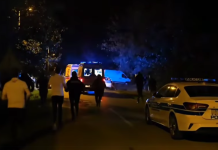

BREAKING: Federal agents accused of staging a “crime crackdown” — newly uncovered documents reveal covert surveillance, questionable arrests, and racial profiling in a sweeping New Orleans immigration operation.
In a wave of explosive revelations, civil rights organizations and investigative journalists say one of the most aggressive federal actions in recent years resembled a mass surveillance dragnet more than legitimate law enforcement.
According to recently reviewed internal records, the Department of Homeland Security did far more than carry out arrests. Agents monitored online discussions, scanned protest pages, tracked keywords, and flagged residents based on vague “behavior indicators” that experts warn are dangerously close to racial targeting.
The operation, publicly branded as Operation Catahoula Crunch, was promoted as a “precision crackdown” on violent offenders. But the numbers tell a different story. Of the first 38 people arrested, only nine faced serious criminal allegations. Several others were detained for expired documents or loosely defined claims of “suspicious movement.”
One of the most troubling details emerged through reporting by the Associated Press, which found that agents were instructed to classify entire neighborhoods as “potential threat sectors” — a label typically reserved for counterterrorism operations. Legal analysts warn that such practices blur the line between immigration enforcement and domestic surveillance, a boundary federal agencies are legally prohibited from crossing.
Community groups describe an atmosphere of fear. Residents reported being followed by unmarked vehicles, questioned in public spaces, and blocked inside apartment complexes. Multiple detainees stated they were denied access to legal counsel for hours, in some cases for nearly an entire day.
Perhaps most alarming, records indicate that federal agents actively monitored social media activity belonging to activists, local journalists, and even church organizations offering shelter to migrants.
“This is not public safety — this is surveillance,” said an attorney affiliated with the ACLU, warning that such tactics pose a direct threat to civil liberties.
Immigration advocates believe the operation was a test case — an experiment designed to measure how far federal authority can be expanded under the banner of crime prevention.
If the evidence holds, Operation Catahoula Crunch could become one of the most controversial federal actions of the decade — not because of who was arrested, but because of how entire communities were treated.
The message is unmistakable.
The line between immigration enforcement and political policing has grown dangerously thin. And millions of Americans are left asking the same question:
If this can happen in one city — what comes next?